The Apple Worcester Forgot—and Is Quietly Remembering
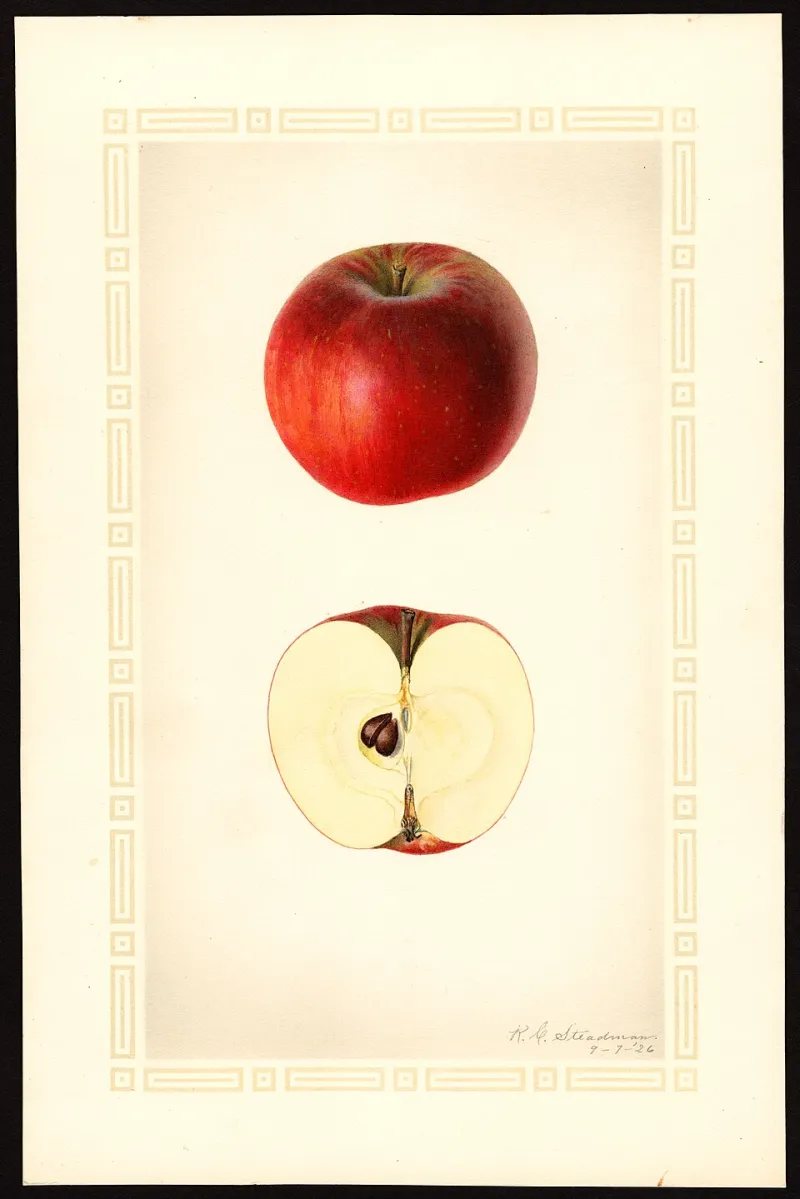
Photo: Royal Charles Steadman, Public domain, via Wikimedia Commons
There is a particular kind of Worcester food story that doesn’t announce itself. It isn’t a new café opening or a sauce winning a prize. It’s the story of an apple that once made the city’s name travel far beyond the county border—and then almost slipped away.
The Worcester Pearmain is that apple. If you have eaten one, you probably remember it: bright red skin, a little strawberry sweetness, and a texture that says ‘eat me now’ rather than ‘keep me until Christmas’. It is an early apple, a September apple, a fruit with a short window and a strong sense of place.
And in 2026, it is having a small, stubborn moment.
A Worcester Apple With a Worcester Story
The Worcester Pearmain was raised in Worcester in the 1870s, in a city that was still surrounded by orchards and market gardens. It became a commercial variety in the decades that followed, valued because it cropped well and ripened early. For a long stretch of the twentieth century, it was a familiar name in British fruit catalogues and on market stalls.
That matters. Most apples have a region attached to them by accident or marketing. The Worcester Pearmain has Worcester in its name because it genuinely came from here. It is part of the city’s food DNA, even if most shoppers today would struggle to pick one out of a fruit bowl.
It also has a useful local quality: it doesn’t need to travel far to be good. Picked and eaten close to home, it is a lovely thing. Sent halfway across the country in a chilled lorry, it becomes a much less convincing proposition.
How It Slipped Out of the Fruit Bowl
The decline wasn’t dramatic. It was a slow drift, the kind that happens when convenience, shelf life and supermarket uniformity start setting the rules.
The Worcester Pearmain is not a long-storing apple. It softens quickly. It bruises if you look at it sideways. It doesn’t sit in a plastic tray for weeks looking identical to its neighbours. For a retail system built on consistency and distance, those are not small problems.
At the same time, orchards in Worcestershire and across the country were being lost or replanted with varieties that suited the new economics better. Growers needed apples that could be stored, packed and shipped without turning to mush. The Worcester Pearmain was pushed from a mainstream crop into something closer to a heritage curiosity.
None of that had anything to do with flavour. It was a logistics problem dressed up as progress. And like many local varieties, it survived mainly because a few growers, allotment holders and orchard enthusiasts kept it going when there was no commercial reason to bother.
The Quiet 2026 Revival
This year, the revival is not a grand campaign. It is happening in small increments: a few more trees in community orchards, a handful of stalls selling local apples by name, and a growing appetite among shoppers for fruit that tastes like something rather than simply looking neat.
Community orchard groups around Worcester and the wider county have been quietly planting heritage varieties, including the Worcester Pearmain, as part of mixed orchards. These aren’t commercial plantations. They are local projects—village halls, school grounds, allotment edges, churchyards and green spaces—where the point is variety, resilience and a bit of local food history.
At Worcester Farmers’ Market and among independent greengrocers, the apple appears in season, usually without much fanfare. You may find it in a mixed bag of local apples, or hear a grower mention it almost in passing. That is the thing about a quiet revival: it doesn’t always come with a label. Sometimes you have to ask.
And in 2026, asking is worth it. The Worcester Pearmain is not a museum piece. It is a genuinely good eating apple when it is fresh, local and in season. Its problem was never that it tasted wrong. Its problem was that it didn’t fit a system that wanted apples to behave like tinned goods.
Where to Find It Without Chasing Ghosts
The honest answer is that you won’t find Worcester Pearmain in most supermarkets. That isn’t a failure of the apple; it’s a failure of the supply chain’s imagination.
Your best bets are local. Look for Worcestershire apple stalls at farmers’ markets in late summer and early autumn. Ask independent greengrocers whether they have local varieties in stock. Visit community orchard open days and apple days, where heritage varieties are often pressed, tasted and discussed. If you have an allotment or a generous neighbour with a tree, September is the month to say yes to a bag.
By November, the fresh season has largely passed. What remains is stored fruit, juice, cider and the memory of a very good apple. That is another reason to pay attention next year: the Worcester Pearmain is a seasonal pleasure, not an all-year commodity.
A Small Apple With a Large Point
The Worcester Pearmain matters beyond nostalgia. It is a reminder that local food isn’t just about farmers’ markets and café menus. It is also about varieties that were bred for a place and then nearly lost because they didn’t suit a national distribution system.
Keeping it alive doesn’t require everyone to become an orchard historian. It requires enough people to buy it when it appears, ask for it when it doesn’t, and support the community orchards and small growers who bother to plant it. That is how a signature apple becomes more than a name on a heritage list.
Worcester has a food identity built on sauce, cafés and a growing independent scene. The Worcester Pearmain belongs in that story too—not as a relic, but as a useful, delicious reminder that some of the best local food is the stuff that never travelled well in the first place.